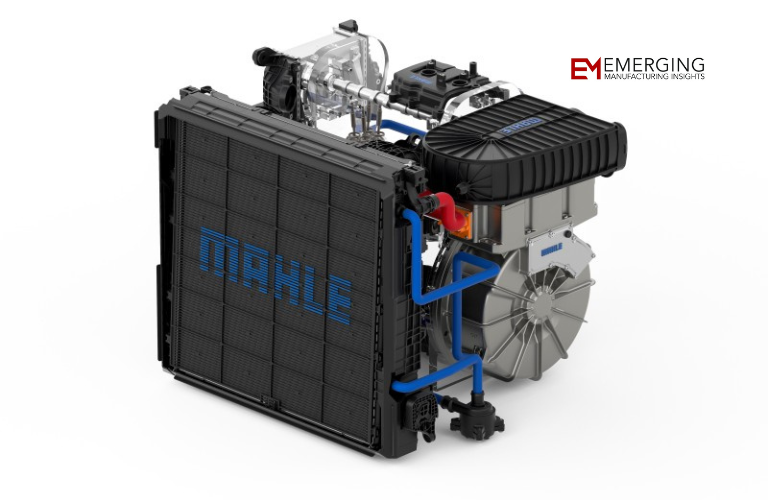
| The new MAHLE range extender system for battery-electric trucks has already aroused considerable interest among customers prior to its world premiere at IAA TRANSPORTATION 2026. The technology group has launched first specific projects with commercial vehicle manufacturers in order to produce prototypes and test vehicles on the road in the near future. The range extender can accelerate the ramp-up of battery-electric commercial vehicles as it provides additional range and flexibility, allowing road haulage companies to combine economics and sustainability. “The positive response from our customers shows that the market needs economical, practicable solutions for electrification,” said Arnd Franz, Chairman of the Management Board and CEO of MAHLE. As another world premiere in Hanover, MAHLE is showcasing a new permanent magnet-free electric motor (MCT) for heavy trucks. This motor does not require any rare earth elements, reduces the weight and improves the efficiency of electric drive systems. MAHLE is calling for technological diversity in political regulation so that battery-electric drive systems, also with range extenders, and high-efficiency technologies for the use of renewable fuels can contribute to the defossilization of road transport. Under the motto of “Electrified. Efficient. Economical.” MAHLE is showcasing innovations for sustainable, economical commercial vehicles at the leading international trade fair for transportation from September 15 to 20, 2026. The MAHLE stand is located in Hall 11 at the Hanover Exhibition Center. |
Electric truck with the everyday capabilities of a diesel The MAHLE Group’s response to these challenges is its new range extender system for electric trucks. This is a smart power unit that starts up at precisely the right time and significantly extends the range of a battery-electric truck as the need arises. “Range extenders may represent a breakthrough for the electrification of road transport at the same time as safeguarding fleet economics,” said Arnd Franz. The range extender is a compact unit combining generator, internal combustion engine, thermal management, fuel tank, AdBlue tank and exhaust gas treatment. The unit can easily be integrated in existing battery-electric vehicle platforms. The main component is a high-voltage generator with a continuous output of 110 kW and a peak output of up to 130 kW. Thanks to its newly developed advanced oil cooling system, the generator has a power density of more than 7 kW per kilogram. The integrated thermal management system with 48 kW of high-temperature and 15 kW of low-temperature cooling capacity also ensures efficient, reliable operation. The range extender replaces about one-third of the present battery capacity of a battery-electric truck. As a result, the rear axle load can be reduced by about 400 kilograms and the total vehicle weight by about 600 kilograms. All in all, a BEV truck equipped with this system can reach a total range of more than 800 km, with the battery providing about 400 km and the range extender the remaining 400 km. Compared with a conventional drive system, the CO₂ emissions in real-life operation can be reduced by more than 80 percent. If HVO100 renewable fuel is used, the truck can be operated with virtually zero CO2 emissions. Another world premiere at the IAA: MCT electric motor without rare earth elements With a peak output of 370 kW and torque of over 900 Nm, the MCT electric motor offers the high power density needed for demanding applications in heavy truck operation. It makes the drive system also up to 10 kg lighter than comparable solutions, further improving vehicle efficiency. In the VECTO driving cycle, the motor has an efficiency of 95 percent. In real-life driving cycles covering a wide variety of applications, the drive system reaches higher efficiency levels than comparable permanent-magnet electric motors. The technology therefore combines resource conservation, high performance and energy efficiency in a future-oriented drive system concept for electric commercial vehicles. Renewable fuels play a key role in defossilization “Technology diversity does not present a conflict for defossilization; on the contrary, it is a prerequisite,” said Arnd Franz. Battery-electric drive systems, hydrogen technologies, renewable fuels and range extender systems should supplement each other with a view to achieving climate targets as rapidly and economically as possible. This will only be possible with reliable regulatory conditions. This is why MAHLE calls for a review of European CO₂ regulations for heavy commercial vehicles in the near future which gives greater consideration to the realities of the marketplace. MAHLE grows with commercial vehicle technologies |