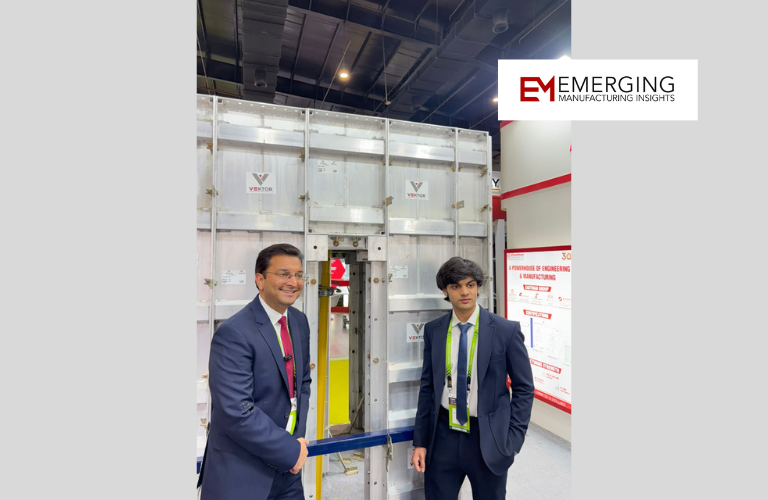
Trishna Patel, Business Head- Procurement at Powerweave in conversation with Emerging Manufacturing Magazine.
Q. What is driving the shift from AI experimentation to measurable outcomes in enterprise procurement?
I think organisations have moved beyond asking, “What can AI do?” and are starting to ask, “What business problem can AI actually solve for us?”
Experimentation has helped procurement teams see AI’s value across sourcing, spend analysis, supplier discovery and workflow automation, with improvements in productivity, speed and decision-making. That is creating a natural progression from experimentation to deployment. Once organisations can attach a clear business outcome to AI, they become more willing to integrate it into procurement.
Q. How important is clean, connected procurement data for organisations looking to scale AI across sourcing and spend management?
It is fundamental. Clean and connected data is the foundation of almost every successful AI initiative in procurement. AI is only as good as the information it is given. If supplier, material, category, transaction and spend data is fragmented, duplicated or poorly structured, the intelligence generated on top will be limited.
We often see organisations exploring AI without fully assessing existing master data: multiple supplier records, inconsistent naming, incomplete categorisation and disconnected spend data. This is where the philosophy behind ewiz procure came from. Working with large procurement environments, we repeatedly saw organisations invest in technology and AI when the underlying data wasn’t ready. That led us to a simple principle: fix the data first, then build intelligence and workflows on top of it.
Before asking AI to generate better insights, organisations need a reliable data foundation. Improving the data itself can unlock value first.
Q. How can enterprises modernise procurement with AI without disrupting their existing ERP and S2P investments?
I don’t think organisations need to rip and replace existing technology to benefit from AI. A practical approach is to use focused solutions alongside the ERP and Source-to-Pay environment, applying AI to supplier discovery, spend intelligence, sourcing analysis or document processing while transactions continue through systems.
We have seen this work in practice. For one customer, SAP remained the system of record while we digitised the PR-to-PO process around it, including RFx creation, supplier responses, comparisons, approvals and supplier compliance, with the PO flowing back into SAP.
In another case, a company using Coupa had fragmented data across hundreds of catalogues. Rather than replacing Coupa, we cleansed, standardised and enriched the data, then loaded it back into the existing environment. More than 8,000 SKUs were standardised.
We have also operated alongside multiple procurement and supplier systems to manage indirect and tail spend across more than 30 countries, working with the existing setup rather than replacing it. This creates a lower-risk path: prove value, learn and expand gradually.
Q. Where do you see the greatest near-term value from AI in procurement, particularly across sourcing, spend visibility and supplier intelligence?
I think the first major impact will be reducing the administrative burden on procurement teams. Procurement is highly process- and compliance-oriented, with time spent gathering information, reviewing documents, preparing analysis and following up with suppliers. AI can remove much of that work and free professionals for strategic priorities.
In sourcing, AI can generate RFQs, summarise supplier responses, compare bids across price, specifications, delivery, risk and ESG criteria, and prepare evaluation summaries. Automated supplier bid comparison is one of our most widely used capabilities because it removes a manual part of sourcing.
In supplier management, AI can read certificates and compliance documents, extract information, highlight risks and support verification. In contracts, it can summarise documents and flag clauses needing attention.
AI-enabled chat intake can also help users raise sourcing requests or approvals through Teams or Slack, while document-reading can pull structured information from procurement files instead of asking buyers to re-key it. Once data maturity is in place, AI can identify spend patterns, anomalies, duplicate supplier records, performance trends and benchmarking opportunities. Over time, it can execute defined parts of workflows within agreed parameters.
So, the progression is simple: reduce administrative workload first, augment decision-making next, then gradually introduce more autonomous workflows.
Q. As AI takes on more procurement decisions, where will human judgement and expertise remain critical?
I don’t see AI replacing human judgement, particularly where decisions have business impact. Context matters, especially in direct procurement, where materials and suppliers can affect operations, quality, production and the customer proposition.
AI can analyse enormous amounts of information and make recommendations, but procurement professionals understand supplier relationships, specification changes, supply continuity, quality, commercial dynamics and business strategy. Their role will evolve rather than disappear. AI will handle more data-heavy and repetitive work, while people spend more time on judgement, negotiation, relationships and strategic decisions.
Ultimately, the best procurement organisations will not use AI to remove people from the process. They will use it to make their people significantly more effective.