India’s infrastructure expansion is driving new demands for structural steel that is engineered for greater performance, durability and project complexity. In this interview, Salasar Techno Engineering discusses how evolving power, rail, industrial and urban infrastructure requirements are shaping steel solutions, while highlighting the role of integrated manufacturing, engineering innovation and execution capabilities in supporting the country’s next phase of growth.
- India is witnessing rapid infrastructure development across power, transport and industrial sectors. How is this changing the demand for advanced structural steel solutions?
India’s infrastructure build-out across power, transport and industrial sectors is not just growing in volume, it is changing in character, and that is reshaping what the market expects from structural steel. On the power side, the push into higher-voltage transmission, renewable energy evacuation and GIS-based substations is driving demand for compact, engineered monopole and lattice structures rather than standard commodity towers. On the transport side, railway electrification, dedicated freight corridors and high-speed rail are creating demand for OHE structures, girders and bridge steelwork that must be manufactured to tight tolerances and certified to independent safety standards. On the industrial side, capacity expansion in steel, cement, EV and process industries is generating demand for heavy plant structures that need to be engineered for specific loads and delivered on compressed schedules. Taken together, this is shifting the market from generic fabrication towards application-specific, engineered-to-order structural steel, where design optimisation, material quality, corrosion protection and speed of delivery matter as much as tonnage. As one of India’s leading integrated structural steel manufacturers, having executed 885+ km of transmission lines and 720+ TKM of railway electrification to date, we see this as a genuine step-up in what infrastructure developers now expect from their steel partners.
- What key engineering innovations are helping make structural steel solutions more efficient, durable and adaptable to increasingly complex infrastructure projects?
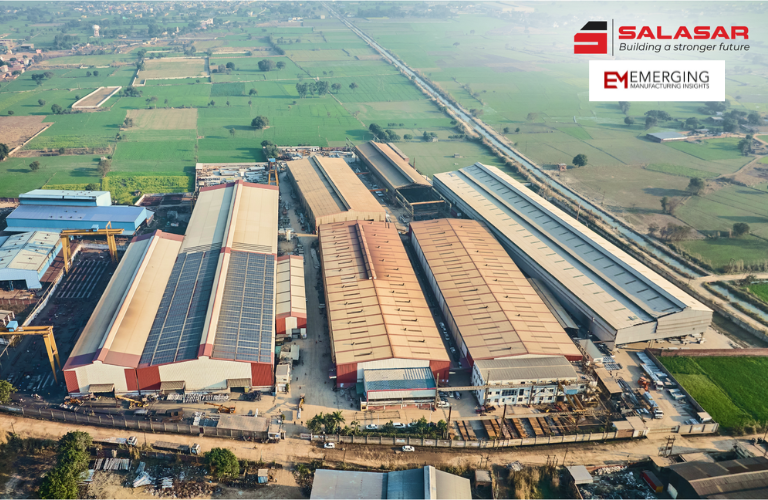
Several engineering shifts are making structural steel solutions more efficient, durable and adaptable. First, design has moved to advanced 3D modelling and load simulation, which allows every structure, whether a transmission monopole, a railway OHE mast or an industrial plant structure, to be optimised for wind, seismic and site-specific loading rather than over-engineered on generic assumptions. Second, the shift from conventional lattice towers to tubular monopole designs is reducing land footprint and erection time while maintaining structural performance, which matters in dense urban corridors and difficult terrain alike. Third, galvanising technology has become a genuine differentiator: our facility is one of Asia’s largest galvanization plants, with a galvanising bath measuring 13 metres in length, 3 metres in width and 3.6 metres in depth, which allows large and complex structures to be galvanised in a single dip. This improves coating consistency, reduces handling and repeat processing, and materially extends structure life in varied climatic conditions. Fourth, automation in cutting, drilling and welding is improving fabrication precision and repeatability across high-volume orders. Finally, we are seeing growing adoption of multi-utility structures, such as smart poles that combine lighting, telecom and surveillance infrastructure, which reflects how structural steel is being asked to do more within the same footprint as urban and industrial infrastructure gets denser and more complex.
- How can integrated manufacturing, from engineering and fabrication to finishing and execution, improve project quality, timelines and overall cost efficiency?
This is central to how we operate, and we see it as one of the clearest levers for improving infrastructure delivery in India. When engineering, fabrication, galvanising and on-site execution sit within a single organisation rather than being split across multiple vendors, three things improve directly. Quality improves because design intent carries through to fabrication and finishing without being diluted across handoffs, and every stage is accountable to the same standard – reflected in our ISO 9001, ISO 14001, ISO 45001 and EN 1090 certifications. Timelines improve because there is no waiting on external fabricators or galvanisers, scheduling across design, manufacturing and erection can be planned and adjusted in real time, and issues at one stage can be resolved without contractual delay at the interface with another. Cost efficiency improves because integration removes the margins and inefficiencies that get layered in at each handoff in a fragmented, multi-agency model, and because in-house galvanising and manufacturing scale allow better utilisation of capacity and procurement. Our recent execution of the full Udaipur-Himmatnagar railway electrification corridor, where we delivered OHE, traction sub-stations and signalling works in phases independently certified by the Commissioner of Railway Safety and RITES, is a good example of how single-partner, integrated EPC execution allows complex, multi-site infrastructure to move faster while still holding up to rigorous, independent scrutiny.
- Looking ahead, which infrastructure segments do you see driving the next phase of growth for India’s structural steel industry, and what capabilities will manufacturers need to support this growth?
We see the next phase of growth being driven by a combination of power, rail and urban infrastructure segments. In power, higher-voltage transmission, including 765 kV corridors, and GIS-based substations will see sustained investment as the grid is strengthened and renewable capacity is integrated, an area we have deepened through our amalgamation with EMC Limited. Railway electrification will continue across zones that are yet to be covered, alongside dedicated freight corridors and high-speed rail, which will keep demand strong for OHE structures and rail-related steelwork. Renewable energy, particularly the evacuation infrastructure that connects solar and wind capacity to the grid, is another segment we expect to scale meaningfully. On the urban side, telecom densification driven by 5G rollout, along with smart city infrastructure such as multi-utility poles, lighting and surveillance systems, will keep adding to demand for lighter, application-specific structures. To support this growth, manufacturers will need integrated EPC capability that spans engineering through execution, larger and more sophisticated manufacturing and galvanising capacity, deeper design capability for higher-voltage and higher-load structures, and the project management discipline to execute multiple large, geographically spread projects in parallel without compromising on quality or safety certification. That is the direction in which we are building our own platform – with exports already reaching 25+ countries, from an integrated manufacturer towards a broader, future-ready infrastructure solutions partner.