ICRA has revised its outlook for the domestic primary non-ferrous metal industry to Positive from Stable, driven by elevated metal prices, healthy domestic demand and a considerable improvement in earnings visibility for primarynon-ferrous metal entities in 2026-27. Global supply disruptions and low metal inventories led to a surge in non-ferrous metal prices by 30-40% during the first five months of the current fiscal. This is expected to boost the operating margins for domesticentities by ~400 bps to ~35% in 2026-27. Given the strong performance, the credit metrics of ICRA’s sample set of companies are likely to substantially improve with an estimated total debt/OPBDITA of 0.6 times and interest cover of 16.0 times in 202a6-27 comparedto total debt/OPBDITA of 0.9 times and interest cover of 12.0 times in 2025-26.
Commenting on the sector outlook, Girishkumar Kadam, Senior Vice-President and Group Head, Corporate Sector Ratings, ICRA said: “The revision in the industry outlook to Positive is supported by the expected strengthening in earnings and credit metrics of non-ferrous metal companies, aided by healthy domestic demand and favourable metal prices. Domestic demand isanticipated to grow by 8-9% in 2026-27, aided by continued investments in infrastructure, construction, power, renewable energy and electric vehicles related segments. For domestic primary aluminium entities, OPBDITA per tonne is estimated to increase to ~$1,575 in 2026-27.Also, the earnings of copper and zinc entities are likely to improve significantly in the current fiscal. However, the movement in global non-ferrous metal prices will remain a key monitorable for the industry, given the inherent cyclicality of commodity prices.Overall, ICRA expects the financial profile of domestic primary non-ferrous metal companies to strengthen significantly in 2026-27.”
Exhibit: Trend in EBITDA/MT (in $/MT) for domestic aluminium players
Source: ICRA Research; Note: P indicates projected value
International prices of all three primary non-ferrous metals (aluminium, copper and zinc) have recorded significant improvement in the current fiscal. Global aluminium prices remain elevated, aided by continued supply disruptionsin West Asia, which accounts for ~9% of the global aluminium production. While aluminium prices moderated in July and August 2026 as war-risk premium eased, persistent supply constraints and low inventories are expected to keep LME aluminium prices elevatedat 3,200-3,300/tonne in 2026-27, implying an annual increase of 18-20%. ICRA projects copper prices to remain high at $12,000-13,000/tonne, representing a growth of ~18% over the 2025-26 average prices. The outlook remains supported by copper concentrate shortagesand tight refined copper availability outside the US market. Zinc prices are also expected to be fuelled by mine supply constraints and declining LME inventories.
While global demand growth remains subdued for non-ferrous metals, the supply side constraints are likely to support market balances. The aluminium market is projected to remain in a deficit of ~1 million metric tonne (MT),considering continued supply disruptions in West Asia. Restoration of disrupted facilities is expected to remain gradual, supporting elevated aluminium prices through 2026-27. The refined copper market is also anticipated to tighten, owing to movement of inventoriesto COMEX warehouses amid uncertainty over US tariffs, thereby reducing refined copper availability outside the US market. Similarly, refined zinc supply is expected to remain constrained by weaker mine production and declining ore grades, with global mineoutput contracting by around 0.5% in 5M CY2026.
ICRA estimates the domestic demand of base metals (aluminium, copper and zinc) to surge by 8-9% in 2026-27. Nevertheless, domestic production of aluminium and zinc continues to exceed consumption. The situation is likely topersist going forward as domestic capacity is elevated and manufacturers are expected to maintain high utilisation level for the plants. This, in turn, would lead to large export volumes. Encouragingly, off-take risks in the international market would remainlow, given the cost competitiveness of the domestic manufacturers. In contrast, lower copper production has created a large deficit in the domestic copper market, resulting in large imports, and the situation is unlikely to improve in the near term.
Exhibit: Trend in demand and outlook for non-ferrous metals
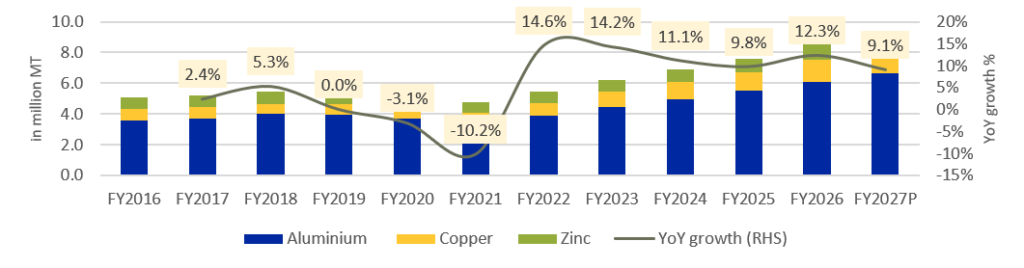
Source: Ministry of Mines, Ministry of Commerce and Industry and ICRA Research