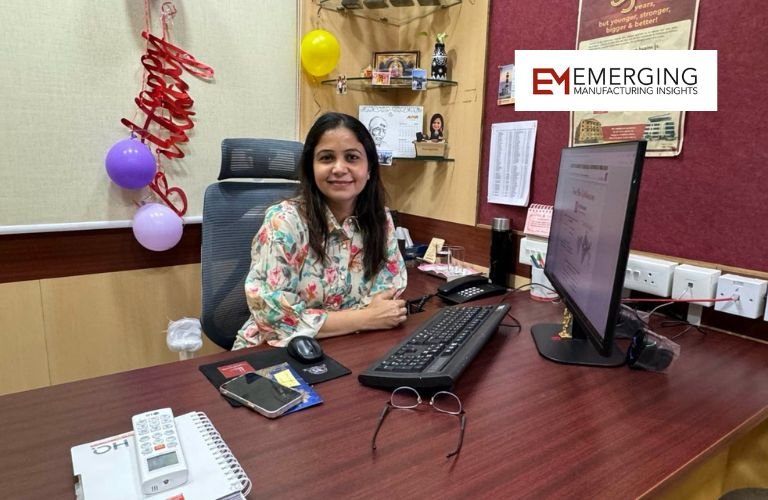
… by Dhwani Maheshwari, Director, Lighthouse Info Systems
Every generation of ERP has solved a different business problem.
What began as a way to digitise transactions gradually evolved into a platform for integrating functions, improving visibility and supporting faster decisions. Today, ERP is entering another phase, one where technology is not merely expected to capture or present information, but increasingly to interpret it and assist the people who act on it.
Having been associated with an ERP organisation for many years, I have had the opportunity to observe this evolution closely. What stands out is not just how much the technology has changed, but how fundamentally our expectations from ERP have changed along with it.
Earlier ERP environments were largely transaction-oriented and dependent on defined systems and structured reporting. Today, web-enabled architectures, mobility, cloud capabilities, multilingual environments and integration with other applications have significantly expanded what an ERP platform can deliver.
But the real shift goes beyond architecture.
From Information to Visibility
One of the most meaningful changes has been the way information reaches decision-makers.
There was a time when management information often had to be compiled before it could be consumed. Teams depended on MIS reports, spreadsheets and people responsible for consolidating information. Decision-making could therefore become a function of how quickly the right information could be collected.
Modern ERP has changed that equation.
Dashboards, KPIs and exception-based reporting can make relevant information available at the point of decision. A manager no longer necessarily needs to wait for a report to understand what is happening. The system can highlight what is performing as expected, what requires attention and where an exception exists.
For a manufacturing organisation, where production, inventory, procurement, sales, quality, finance and logistics continuously influence one another, this visibility can be particularly valuable.
The objective is no longer simply “Where is the data?” It is increasingly “What does the data tell me, and what requires my attention?”
Integration Is Becoming the Real Value
Manufacturing has never operated through isolated functions. Yet historically, different systems and processes often worked in silos.
That is changing.
ERP today is expected to connect not only internal functions but also machines, suppliers, customers, banks and other specialised applications. APIs and modern integration capabilities are making it easier to create an ecosystem where information can move across systems rather than remain confined within them.
For manufacturing organisations, this can create a significant advantage. When processes and stakeholders are connected, collaboration improves, data becomes more accessible and the organisation can respond faster.
ERP is therefore gradually becoming less of an application and more of an organisational backbone.
Its value lies not simply in the number of transactions it can process, but in how effectively it connects the organisation around those transactions.
Technology Can Enable Change. People Still Have to Adopt It.
This is perhaps the part of digital transformation that is easiest to underestimate.
A sophisticated ERP system does not automatically create a sophisticated organisation.
Whenever a new system or process is introduced, there is a human response to it. Some people embrace new technology quickly, while others find it difficult because they are accustomed to established ways of working.
In my experience, this is less about age and more about mindset and willingness to learn.
Training, therefore, cannot be treated as an implementation formality. Organisations need to help people understand not only how to use a system, but why the new way of working matters.
The same applies to process discipline and data quality. An ERP can provide structure, automation, visibility and control, but it still depends on people following the processes and maintaining reliable information.
This is also why change management remains an important part of ERP transformation. Technology may evolve rapidly, but successful adoption will always depend on the people using it.
And Then There Is AI
AI is now pushing ERP towards its next significant evolution.
The traditional ERP experience has often required users to know where to look for information. Increasingly, AI allows the possibility of asking the system what we want to know, identifying exceptions automatically and receiving assistance in completing repetitive tasks.
Many of these capabilities are already emerging. Over time, they are likely to become a normal part of enterprise applications rather than something considered innovative or experimental.
But I do not see AI as a simple story of machines replacing people.
AI can perform tasks, generate code, analyse information and significantly improve productivity. But it still needs human intent. Someone has to define the requirement, provide the context, ask the right question, evaluate the output and decide what should happen next.
A machine can generate an answer. It still takes a human to ask the right question—and to decide what to do with the answer.
In my view, AI will increasingly take over repetitive and mechanical tasks, while enabling people to focus more on judgement, accountability, problem-solving and decision-making.
What Comes Next?
The next generation of ERP will probably be defined less by how much information it can store and more by how intelligently it can use that information.
We are moving from:
Capturing transactions → connecting processes → providing visibility → generating insights → enabling decisions.
The next step may be systems that proactively identify patterns, anticipate exceptions and bring the right information to the right person before a problem becomes visible through traditional reporting.
Many of these capabilities are already beginning to emerge. The next few years will likely see them become more mature, practical and deeply integrated into everyday business processes.
After watching ERP evolve through multiple generations, one conclusion is clear to me: ERP is not just about software.
It is about creating systems that bring together processes, information, people and technology in a way that helps an organisation operate better.
The future of ERP, therefore, may not be about replacing the human decision-maker.
It may be about giving that decision-maker better information, earlier insight and more time to focus on the decisions that truly require human judgement.