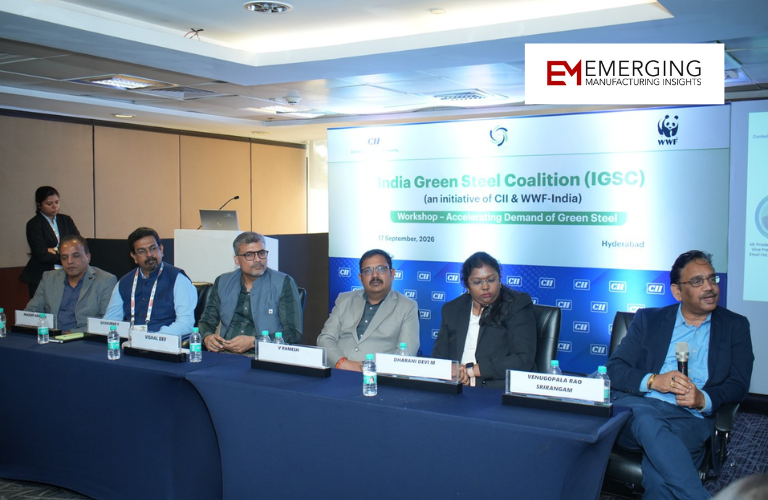
Long-term buyer commitments, clearer pricing mechanisms and stronger producer–buyer linkages emerged as key enablers for accelerating demand for low-carbon steel in India, as the India Green Steel Coalition (IGSC), a joint initiative of the Confederation of Indian Industry (CII) and WWF-India, convened a workshop on “Accelerating Demand of Green Steel” in Hyderabad. Bringing together over 70 stakeholders from steel producers, large industrial buyers, sustainability professionals and other stakeholders, the workshop examined the demand-side enablers needed to support the growing market for green steel. The Coalition brings together stakeholders across the steel value chain, with its members representing around 70% of India’s crude steel production.
The workshop, themed “Driving the Transition to Low-Carbon Steel in India” focused on the commercial, technological and operational factors that could shape the pace of India’s steel transition. Discussions covered long-term procurement and offtake commitments, green steel pricing and premiums, technology adoption, access to clean energy and investment requirements, with participants exploring how greater demand certainty and transparent commercial frameworks could strengthen producer–buyer linkages, create clearer market signals and build confidence for investments in low-carbon steel making.
In the session on “Navigating Low-Carbon Steel making, Clean Energy & Investment Challenges,” Ms. Gargi Mohanty, Senior Manager, Corporate Sustainability, Tata Steel, highlighted the importance of building a strong and collaborative steel ecosystem, noting that India is the world’s second-largest steel producer and consumer. She highlighted India’s path-breaking step of becoming the first country to introduce a Green Steel Taxonomy in 2024, based on carbon emission intensity during the steel production process. The taxonomy introduces a star-rating system to categorize green steel based on defined carbon emission intensity thresholds. Ms. Mohanty outlined 14 levels of the green transition and highlighted the sector-wise potential for green steel, emphasizing that accelerating the transition will require collective action from both producers and consumers.
The demand-side perspective was examined in “Driving Green Demand, Navigating Premiums & Securing Supply,” led by Mr. Amrit Sahu, Category Lead, Sourcing & Procurement, Blue Star. The discussion highlighted the challenges buyers face in integrating low-carbon steel into procurement strategies, particularly around green premiums, availability, quality and supply reliability. He outlined three key expectations from green steel producers: verified carbon data, predictable pricing and assured supply. Steel mills that provide credible carbon data, a clear price band and visibility on capacity will be better positioned to secure long-term buyer commitments. He also stressed that the green steel premium must be sufficiently clear and predictable for OEMs to plan procurement and make informed purchasing decisions.
A key highlight was a fireside chat on “Aligning Production, Buyer Commitments & Market Pricing,” which brought together representatives from My Home Constructions, RMI Energy Solutions India Foundation, JSW Steel, L&T, Kirloskar Brothers and Ford Motor Company. Moderated by Mr. Vishal Dev, Director, Sustainable Business, WWF-India, the discussion examined how stronger buyer commitments could create greater market certainty for producers, while transparent approaches to pricing and premiums could support procurement decisions.
The event underscored the importance of aligning steel production with evolving market demand. Discussions focused on the need for stronger linkages between production planning and customer requirements, alongside greater clarity on the availability, pricing and performance of low-carbon steel. Such alignment will be critical to integrating low-carbon steel into mainstream procurement decisions.
The event concluded by emphasizing the role of sustained collaboration across the value chain. Steel producers, buyers, policymakers, financial institutions and technology providers will need to work together to address the commercial, technological and institutional barriers to scaling low-carbon steel in India.