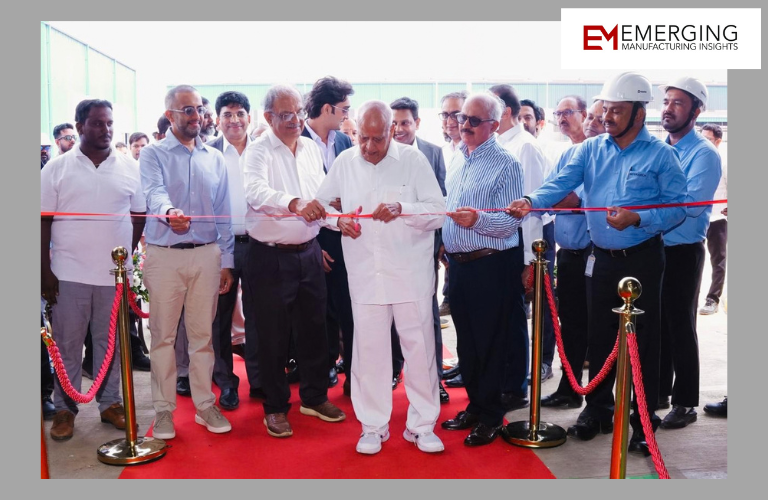
…. Arun Bhat, President, NASH Industries
India’s electronics manufacturing story is entering a new and more demanding chapter. The industry’s volumes are up, product lines are more varied than they used to be, customers want shorter lead times, and they still expect zero compromise on quality. Factories across India have responded by adding more machines, more sensors and more automation. The outcome is a shop floor that generates far more data than any team can process by hand.
This complexity is a sign of progress, but it also raises the stakes. A single line stoppage, a quality deviation, or an unplanned maintenance event can now ripple across an entire production schedule. As Indian manufacturers expand capacity and take on more complex products, reacting faster will not always be enough. The ability to see further ahead and understand the likely consequences of a decision before making it is becoming increasingly important.
This is where digital intelligence, and specifically digital twins, come into play.
Beyond watching the shop floor
Over the last decade, most manufacturers have already invested in connecting their equipment. Sensors are tracking machine health, dashboards are showing live output while alerts fire away when something looks off. This connected-factory model has been valuable, but it is fundamentally reactive. It tells you what is happening, and in many cases what has already happened. It does not always tell you what is likely to happen next or what the best response should be.
Digital twins go a step further. A digital twin is a virtual representation of a machine, a production line or an entire factory that is continuously updated using real operational data. The level of detail can vary, but the underlying idea is simple: create a digital environment in which manufacturers can understand and test how a physical system may behave.
That changes the conversation.
Engineers and manufacturers can simulate a new production sequence, model the impact of a new product variant or test a layout change on the digital model before making changes to the actual equipment. The shift is from understanding what is happening to predicting what could happen, and from there, to identifying the best possible course of action.
That, in my view, is the real promise of intelligent manufacturing.
Where the value shows up
The applications are already tangible. New lines can be planned and tested virtually before they are built, which can reduce the time between design and first output. In day-to-day operations, digital twins can help identify bottlenecks and optimise throughput without the trial-and-error cost of experimenting on live equipment.
This becomes particularly important as manufacturing becomes more complex. A change to one process can have an impact on several others. Being able to model those interactions before making a physical change can help manufacturers make better decisions and avoid costly mistakes.
Predictive maintenance is another area of significant impact. Instead of servicing equipment on a fixed schedule or having to wait for equipment failure, teams can use data and twin-based models to understand how equipment is likely to perform and identify when intervention may be required. The objective is not simply to predict a failure, but to decide when maintenance can be carried out with the least disruption to production.
Quality can improve in parallel. Virtual models, when combined with process and production data, can help manufacturers identify relationships between process conditions and defects earlier, rather than only after problems appear in finished products.
Energy efficiency, a crucial boardroom priority in today’s evolving manufacturing landscape, also benefits. By running different production scenarios through the twin, factories can identify where energy is being used inefficiently and assess possible changes before implementing them. This matters more each year as global buyers pay closer attention to how sustainably their suppliers operate.
What this means for India
For Indian electronics manufacturers, digital twins offer a way to scale intelligently without repeating the same expensive mistakes at a larger scale. As companies expand capacity to meet both domestic demand and export ambitions, the discipline that digital twins bring can help avoid costly missteps and shorten the learning curve that traditionally comes with rapid growth.
This is particularly relevant for India because the next phase of manufacturing growth will not be defined only by how much capacity we build. It will also be defined by how quickly and consistently that capacity can deliver the quality, reliability and flexibility expected by global customers.
A manufacturer that can test a change digitally before implementing it physically has an advantage. It can make decisions with greater confidence, respond faster to changing requirements and potentially reduce the cost and risk associated with experimentation on the shop floor.
But this transformation extends beyond technology. It also has a human dimension.
As factories get more digitally sophisticated, reading, building and acting on a virtual model will become increasingly important skills for engineers. These capabilities should not remain limited to specialist teams. The engineer of the future will need to understand not just the machine and the process, but also the data and the digital model that represent them.
Investing in this capability now will help Indian manufacturers compete not just on cost but on precision, reliability, flexibility and speed — qualities that global customers increasingly demand.
What comes next
Digital twins do not operate in isolation. Their real power emerges when they work together with artificial intelligence, IoT and advanced analytics.
AI algorithms can use data from real operations and digital models to move beyond simply describing what has happened towards predicting possible outcomes and recommending actions. This could mean identifying a suitable maintenance window, evaluating different production sequences or finding a more energy-efficient operating mode before a change is made on the shop floor.
But there is an important point here. AI and digital twins should not be viewed as separate technologies competing for attention. The value comes from bringing them together with good operational data, sound engineering models and the experience of the people running the factory.
As these capabilities come together, factories will start behaving less like fixed assets and more like systems that can continuously learn, adapt and improve.
For India’s electronics sector, this is more than another step in the automation journey. The next competitive advantage may not simply come from having more machines or collecting more data. It may come from being able to make better decisions before those machines are switched on.
The factory of the future, in many ways, will first exist as a digital model — a place where manufacturers can test, learn and improve before making changes in the physical world.
That is where digital twins can make a real difference to the next phase of India’s manufacturing growth.