
Author –
Mathew Thomas,
Country Manager – India,
Siemens Digital Industries Software
As manufacturers worldwide accelerate their digital transformation journeys, India is emerging as a key market where AI adoption is moving from experimentation to large-scale implementation. According to Deloitte’s State of AI in the Enterprise 2026 report companies in India are doing better than companies in countries when it comes to using Artificial Intelligence for all parts of their business. These companies are using Artificial Intelligence to make their work easier better. The report also says that more and more companies are using Artificial Intelligence in areas like making products doing daily work and managing supplies. This shows that companies are moving towards using data and Artificial Intelligence to make their work smarter. As India becomes a place, for making things Artificial Intelligence, automation and Industry 4.0 technologies will help companies make their work stronger, easier and smarter.
Despite the tangible rewards of AI integration, however, it can be easy to encounter stumbling blocks that prevent companies from reaching their full potential. This is why it is critical that manufacturers strategically implement AI instead of applying it indiscriminately to all functions and workflows.
Businesses will best see the advantages of AI when they take traditional, generative and agentic into their own hands and work to tailor it to their workflows and goals. Factories that develop a roadmap for how they will deploy AI ensure that their projects align with their needs, enabling them to improve their chances of successfully implementing AI and positioning them for a future lead by AI.
From foundational steps to full-scale AI adoption
Expediting AI integration starts with understanding where an organization is at in its digital transformation journey, so that the organization can deploy AI to scale. This process of becoming digitally mature is distinct for each business. Approaching AI transformation while acknowledging specific problem areas sets the foundation for businesses to tackle problems that will become more and more complex in the future.
Not to mention, jumping immediately into integrating more advanced solutions like LLMs and agentic AI prematurely may lead to unforeseen disruptions. For this reason, companies should start simple and gradually introduce more complex AI functionalities. Straightforward tools such as command prediction during the product or part design process, for example, can reduce repetitive tasks for engineers and designers. While companies get a feel for their distinct AI needs and determine what is and is not working. Then companies can start forging their unique path toward digital transformation.
Once the organization is comfortable with less complex solutions and has a clearer understanding of its AI roadmap, it can begin introducing more advanced capabilities, such as AI-enhanced topology optimization for part and component design, or other tools tailored to its specific requirements. This gradual scale-up allows businesses to identify best practices, make better use of historical data, and move forward with greater confidence in their AI implementation.
India’s manufacturing sector is also seeing a steady shift towards AI-led transformation, as businesses look to improve productivity, efficiency and competitiveness. As India continues to emerge as a global manufacturing hub, industries are increasingly adopting technologies such as automation, industrial IoT and AI-powered analytics to modernize operations. Industry estimates indicate that AI adoption among Indian enterprises is accelerating, with organizations exploring use cases such as predictive maintenance, quality control and process optimization. For manufacturers, starting with targeted AI applications can help build confidence, unlock value from existing data and create a strong foundation for more advanced solutions in the future.
At this stage, a company can begin training its own AI models to enhance and optimize its processes. With customized solutions designed to address specific business challenges, machine builders can fully integrate generative AI and AI agents into their workflows to create new engineering and manufacturing content, while also automating complex processes.
AI for every role, at every stage
Digital transformation will not look the same for each company or even across individual departments and even individual users in one company. And they shouldn’t, which is why it is essential that businesses consider who will be using each solution. To empower everyone regardless of AI training and knowledge within the organization to use AI to its full advantage, organizations must deploy solutions that work for every position. If all AI skill levels can reap the benefits of data-driven manufacturing, businesses can proficiently use their data to solve issues; especially those unique to its operations.

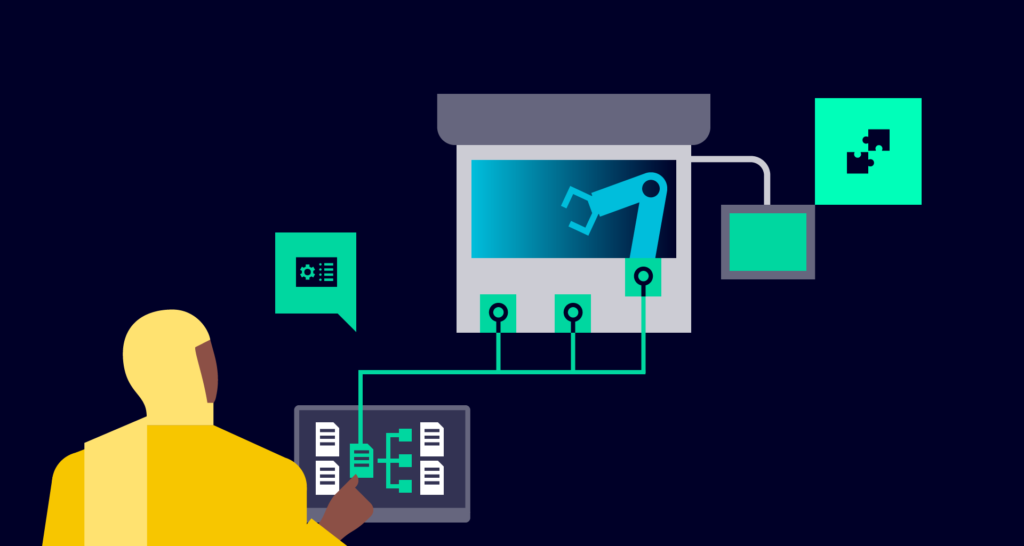
Solutions available today, such as condition monitoring and predictive maintenance, are already making machine data easier to understand without requiring formal training in app development or programming. Designed to be intuitive, these tools can give frontline employees greater visibility into equipment status and key performance indicators.
Meanwhile, design and production engineers with a deeper understanding of machine programming and manufacturing processes can use AI to configure tailored tools for quality prediction and process optimization. They can also interact with copilots and other LLMs through natural language to complete tasks such as command searches or design-related queries.
The versatility of AI-enabled tools makes them valuable for both large enterprises and SMBs. For SMBs, software-as-a-service models lower the barrier to entry by reducing the need for heavy on-site infrastructure. Large enterprises, on the other hand, can benefit from scalability and integrate these capabilities into existing systems. Overall, it is important to adopt AI solutions that can support a wide range of workers and businesses at different stages of digital maturity.
For India’s manufacturing ecosystem, where small and medium-sized businesses form a significant part of the industrial landscape, accessible AI solutions can play a transformative role. Initiatives such as Make in India and the growing focus on smart manufacturing are encouraging businesses to embrace digital technologies without requiring large-scale infrastructure investments. Cloud-based AI platforms, automation tools and intuitive digital solutions can help Indian manufacturers improve operational visibility, strengthen decision-making and compete more effectively in an increasingly connected global market.
A tailored path to AI success
The future is clear: companies will increasingly use intelligent tools to drive efficiency, innovation and transformation across every aspect of engineering. More businesses are accelerating efforts to integrate AI into everyday processes to keep pace with competitors and partners. As AI solutions continue to advance, companies that have already started their digital transformation journeys are beginning to see the benefits.
To gain a competitive edge and avoid common pitfalls, businesses must put AI-powered tools to use in the right places and with the right people. AI is not one-size-fits-all, but integrating it is now easier than ever. It starts with understanding the organization’s needs.