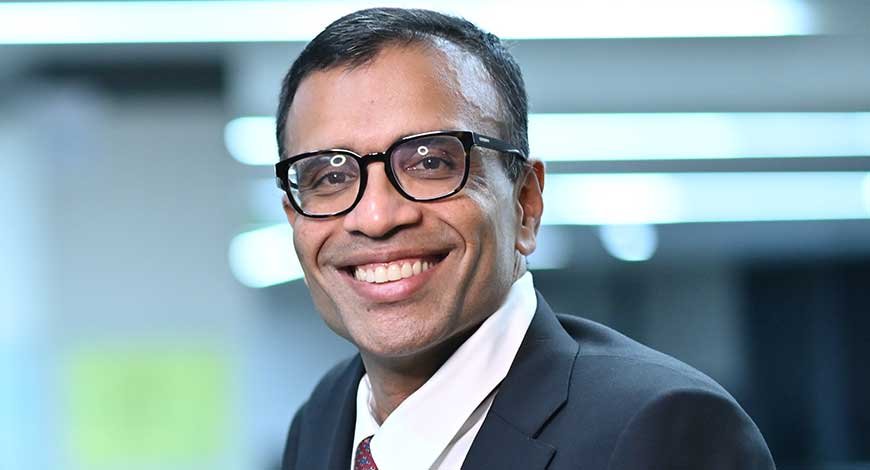
Author –
Mathew Thomas,
Country Manager – India,
Siemens Digital Industries Software
In this authored article, Mathew Thomas, Country Manager, India, Siemens Digital Industries Software, shares his views on how Siemens’ global perspective on AI and the digital twin can be applied to India’s evolving manufacturing priorities.
Manufacturing competitiveness increasingly depends on how quickly organisations can improve efficiency, manage complexity and respond to changing market needs. For sectors such as industrial machinery, automotive, electronics, pharmaceuticals and energy, this requires better ways to design, test and optimise products and production systems.
This is especially relevant in India, as the country expands its manufacturing capabilities, strengthens domestic value chains and seeks a larger role in global production networks. The National Manufacturing Mission has identified technology availability, future-ready skills, quality products and competitiveness as key priorities for Indian industry.
As industrial systems become more sophisticated, traditional development and production methods are under pressure. Physical prototypes, live equipment testing and manual engineering processes can increase costs, delay deployment and limit experimentation.
This is where artificial intelligence and the digital twin can help create a new model for industrial transformation.
The Growing Need to Make Simulation More Accessible
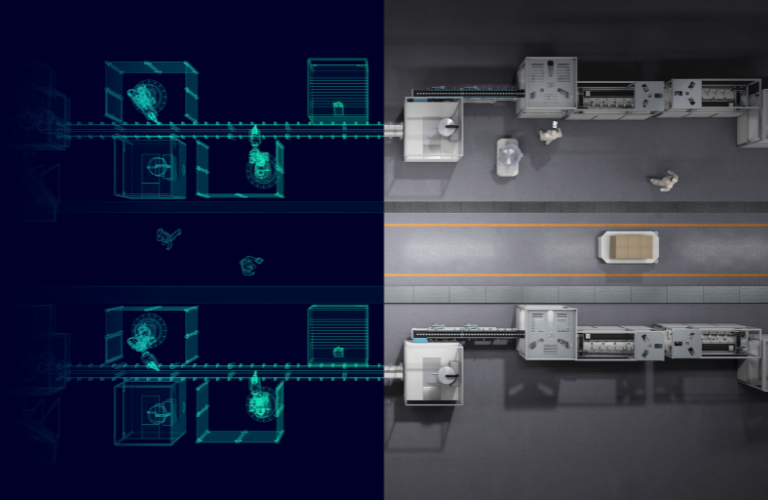
A digital twin enables manufacturers to create a virtual representation of a product, machine, production line or complete industrial system. Engineers can use this virtual environment to test different scenarios, identify potential issues and make informed decisions before investing in physical builds.
The benefits are significant. Manufacturers can evaluate multiple design or production alternatives without taking equipment offline. Testing and verification can often be completed in a shorter time, while physical waste, rework and development risk can be reduced.
However, simulation has traditionally required specialised skills. Organisations may have access to advanced engineering tools but lack enough professionals who are trained to configure and use them effectively.
This has limited the adoption of digital twins, particularly in industrial machinery and production environments where engineering teams are already managing tight timelines and complex systems.
Artificial intelligence can help address this barrier by making simulation easier to configure and use. AI can assist with tasks such as recognising boundary conditions, suggesting material properties and reducing the time required to set up a simulation.
This allows less experienced users to engage with simulation while enabling specialists to complete their work more efficiently.
AI Can Help Democratise the Digital Twin
The ability to make digital twin technology accessible to a wider group of users is becoming increasingly important for India.
The country’s industrial growth is creating demand for engineers and technicians who can work across mechanical engineering, automation, software, data and manufacturing. However, organisations cannot rely only on a small number of specialists to drive every digital transformation initiative.
AI-enabled engineering workflows can help bridge this skills gap. By making complex tools more intuitive, AI can enable professionals from adjacent disciplines to work more effectively with simulation and digital twin environments.
A mechanical engineer could gain more meaningful insight into automation behaviour. An automation engineer could engage more easily with a simulation environment. A production specialist could evaluate process changes without requiring extensive support from a separate technical team.
This does not eliminate the need for expertise. Instead, it allows experts to focus on higher-value decisions while helping a broader group of professionals work productively with digital engineering tools.
For Indian manufacturers, this could support faster adoption across plants, engineering centres and supplier ecosystems.
From Virtual Testing to Real-Time Industrial Intelligence
The digital twin becomes even more valuable when it operates alongside physical equipment in real time.
An executable digital twin can help manufacturers monitor the behaviour of machines and production systems, identify anomalies and support predictive maintenance. Instead of waiting for equipment to fail, organisations can use real-time insights to determine whether a machine requires immediate intervention or can continue operating safely until maintenance or replacement parts are available.
This can help reduce unplanned downtime and improve the utilisation of industrial assets.
In a country where manufacturing capacity is expanding rapidly, improving the reliability of existing equipment will be as important as building new production infrastructure. Even incremental improvements in machine availability, production continuity and maintenance planning can create significant value when applied across multiple facilities.
The use of AI-powered vision systems is another example of how the digital twin can be connected to real-world operations. Visual data can help identify issues such as coolant-flow problems, chip accumulation or other conditions that may affect machine performance.
When this information is fed back into the digital environment, engineers can build a more accurate understanding of how equipment behaves under different operating conditions.
Synthetic Data Can Strengthen Industrial Simulation
One of the challenges in industrial simulation is that machines rarely fail in predictable or repeatable ways. As a result, organisations may not have enough real-world failure data to train AI models or test how equipment will respond under stress.
AI can help generate synthetic data that represents rare or difficult-to-capture scenarios. This can make virtual machines and digital production environments more realistic and enable engineers to test situations that may not occur frequently in normal operations.
For example, a manufacturer could evaluate how a machine behaves under unusual operating conditions, assess the potential impact of a component failure or determine whether production can continue safely while awaiting maintenance.
This creates a continuous improvement cycle. Data from physical operations can inform the digital twin, while insights generated in the virtual environment can improve decisions in the physical factory.
Over time, the digital twin becomes more accurate, more useful and more closely connected to the realities of industrial operations.
India’s AI Momentum Strengthens the Opportunity
India’s growing focus on AI creates a favourable environment for the wider adoption of AI-enabled industrial technologies.
Initiatives such as the IndiaAI Mission can help build broader capabilities in areas such as compute capacity, datasets, skills and responsible AI.
For manufacturing, the opportunity is to ensure this momentum also supports industrial use cases.
AI-enabled digital twins can help advance the country’s manufacturing priorities by enabling organisations to:
- Reduce physical prototyping and material waste;
- Improve machine reliability;
- Accelerate product and production development;
- Train employees in virtual environments;
- Optimise production processes; and
- Test AI models before they are deployed in live operations.
The opportunity extends across both large enterprises and smaller manufacturers. The National Manufacturing Mission is intended to cover small, medium and large industries, making scalable and accessible digital technologies important to the broader manufacturing ecosystem.
Building the Industrial Factory of the Future
The combination of AI, simulation and digital twins can change how factories are designed and operated.
Instead of using digital tools only after problems emerge, manufacturers can use them proactively to evaluate designs, test production scenarios and identify risks before they affect operations.
AI can support the creation and interpretation of simulation models. The digital twin can provide the physical and engineering context. Together, they can help organisations move towards more flexible, resilient and data-driven production systems.
This approach also creates opportunities for continuous optimisation. A production line does not need to remain fixed once it has been commissioned. Its digital representation can be updated with operational data and used to evaluate improvements throughout its lifecycle.
For Indian industry, this could be particularly valuable as companies expand across locations and seek to standardise performance while adapting to local production requirements.
The Road Ahead
The convergence of AI and the digital twin marks an important evolution in industrial transformation. Digital twins already help manufacturers make better decisions before committing resources to physical builds; AI extends this value by simplifying simulation, supporting less experienced users, generating synthetic data and enabling real-time industrial insights.
For India, this aligns closely with the ambition to build a more competitive, technology-driven manufacturing ecosystem. Manufacturers do not need to transform everything at once. Focused use cases such as virtual validation, machine monitoring or predictive maintenance can provide a practical starting point before expanding across more systems, teams and workflows.
Industrial organisations that combine physics-based simulation, real-time operational data and AI will be better positioned to design more efficiently, operate more reliably and respond faster to change. In this next phase of manufacturing, AI will not replace the digital twin; it will make it more intelligent, accessible and valuable — helping India’s factories move from digital representation to continuous industrial improvement.