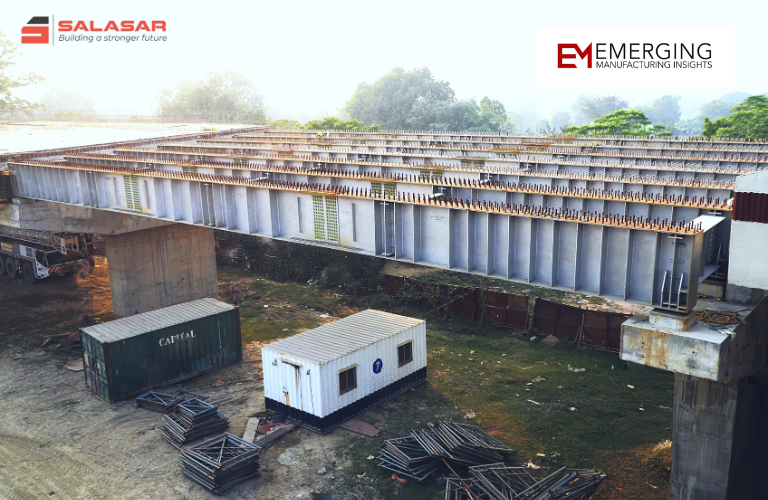
Salasar Techno Engineering, a leading engineering, procurement and construction (EPC) player in India’s telecom, power transmission and infrastructure sectors, has designed, fabricated and supplied 2,085 MT of composite steel girders for 8 spans of Delhi’s Barapullah Phase-III elevated corridor near Hazrat Nizamuddin Railway Station. The corridor is scheduled to be inaugurated on 29th September 2026 by Union Home Minister Amit Shah and Delhi Chief Minister Rekha Gupta, marking the completion of a project long awaited by the city.
Salasar’s spans range from approximately 30 metres to 45 metres in length, with a uniform width of 14.85 metres centre-to-centre. Individual span weights vary from approximately 142 MT to 394 MT, reflecting the differing load and geometry requirements across the corridor’s approach and crossing sections. Fabrication began on 7th June 2024, and girder dispatch ran from 17th August 2024 to 14th February 2025, covering all 8 spans. Approximately 150 personnel were deployed for fabrication over the course of the project.
The Barapullah Phase-III corridor includes an extradosed crossing over the Yamuna, a hybrid between a conventional girder bridge and a cable-stayed bridge that uses shorter pylons with cable support to carry longer spans. In such structures, the girder itself, and not just the cables, carries a significant share of the load, making tight quality control and precision tolerances central to the fabrication process. Salasar’s scope covered design, fabrication and supply of the composite steel girders.
“Fabricating composite steel girders for a landmark Delhi corridor reflects the depth of our engineering and manufacturing capabilities, said Shashank Agarwal, Managing Director, Salasar Techno Engineering. “It speaks to our fabrication precision, our delivery discipline across a dispatch schedule spanning several months, and our commitment to Make in India engineering.”
The project further reinforces Salasar Techno Engineering position as a diversified EPC and manufacturing partner supporting India’s critical infrastructure development. With capabilities spanning telecom, power transmission and distribution, railways, renewable energy and customised steel structures, the company continues to expand its presence across infrastructure segments while leveraging its integrated manufacturing and engineering capabilities.